
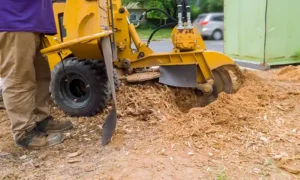
 Integrating natural trees alongside custom hardscaping features like interlocking concrete pavers, flagstone walkways, or brick patios creates a stunning outdoor aesthetic. However, when one of those trees must be removed, eliminating the remaining stump without destroying the adjacent decorative stonework poses a major technical challenge.
The high-velocity cutting wheel of an industrial stump grinder generates intense vibrations and throws heavy debris that can easily shatter, scratch, or dislodge nearby stones. Employing highly targeted, careful protection strategies is essential to neutralize the stubborn wood while preserving the pristine condition of your valuable hardscaping investment.
Establishing Heavy Duty Physical Shields and Debris Barriers
The spinning wheel of a stump grinder acts like a high-powered catapult, throwing dense wood shards, hidden rocks, and packed soil at extreme velocities. If these flying projectiles strike an unprotected decorative paver patio, they can easily cause deep chips, cracks, or permanent surface staining.
- Technicians erect interlocking plywood walls or heavy-duty ballistic curtains directly between the active grinding zone and the edge of the stonework.
- Thick rubber blasting mats are laid flat across the nearest rows of pavers to absorb the direct impact of any stray debris falling from the machine.
- Ground crews utilize industrial geotextile fabrics underneath the protective mats to catch fine sawdust, preventing organic oils from bleeding into porous stone surfaces.
Creating a robust, impenetrable perimeter ensures that the violent forces of the grinding process never make direct contact with your finished walkway.
Mitigating Machine Weight Distribution to Prevent Stone Cracking
Commercial stump grinders are incredibly heavy pieces of machinery that can exert thousands of pounds of concentrated pressure through their wheels or tracks. Driving this massive equipment directly over a decorative paver installation can easily crack individual stones, compress the underlying sand base, and cause widespread surface dipping.
- Operators lay down specialized high-density polyethylene outrigger pads or thick plywood tracks to distribute the machine’s weight evenly across a wider surface area.
- The path of the grinder is carefully planned to minimize tight turning maneuvers, which can pinch, twist, and dislodge individual interlocking blocks.
- Crews utilize compact, lightweight articulating walk-behind grinders specifically designed to access tight spaces without the crushing weight of riding units.
Distributing the machine’s physical load protects the precise leveling of your hardscaping, ensuring your walkway remains perfectly flat and structurally sound.
Utilizing Precision Depth Control and Hand Tool Excavation
The sprawling root systems of mature trees often grow directly beneath or between decorative pavers, intertwining with the compacted gravel base materials. Running a mechanical grinding wheel blindly into this zone will instantly chew up the stone borders and destroy the edge restraints holding the patio together.
- Technicians carefully use hand tools, such as narrow trenching spades and root-pruning saws, to gently sever the anchor roots closest to the stone edge.
- The mechanical grinder is operated at a highly disciplined, shallow depth, focusing exclusively on the center of the stump core away from the hardscaping.
- Operators utilize a specialized sweeping technique that allows them to shave the wood down millimeter by millimeter with absolute visual precision.
Slowing down the removal process and combining manual hand cuts with mechanical precision prevents the grinding teeth from catching and lifting your decorative stones.
Stabilizing the Underground Sub Grade to Prevent Future Settling
When a massive tree root system is ground down and pulverized, it leaves behind a large underground void filled with loose, spongy organic mulch. Over the following months, this organic material decays and compresses, which can cause the adjacent paver base to shift into the empty space and cave inward.
- Ground crews meticulously excavate the loose, freshly generated wood chips from the pit instead of burying them under the walkway.
- The empty root cavity is filled with layers of crushed angular gravel and coarse structural bedding sand rather than standard loose topsoil.
- Technicians use mechanical plate compactors to densely pack the new base material, ensuring it mimics the structural load-bearing capacity of the original earth.
Rebuilding a solid, unyielding foundation beneath the ground guarantees that your decorative walkway will never sag or separate long after the tree is gone.
Implementing Chemical Rot Prevention Along Hardscaping Borders
When a stump is located directly flush against a retaining wall or paver border, mechanical grinding wheels simply cannot get close enough without causing catastrophic impact damage. In these ultra-tight clearance zones, arborists must combine conservative grinding with targeted biological treatments to neutralize the remaining wood safely.
- The crew grinds the accessible portion of the stump as close to the stone as safety allows, leaving a small, isolated wooden shelf behind.
- Deep vertical holes are drilled directly into the remaining wood block to accept natural, specialized salt treatments that accelerate dry rot.
- The treated wood fibers soften rapidly over several months, allowing the property owner to easily chip away the dead material with a hand trowel later.
Blending mechanical removal with smart chemical treatments allows you to completely dissolve the stubborn wood without scratching a single nearby paver.
Securing Master Level Craftsmanship for High Stakes Hardscaping
Successfully managing a high-stress project like grinding a stump right next to a custom paver installation requires a level of patience and skill that amateur operators simply cannot provide. One wrong move or rushed cut can instantly result in thousands of dollars in property damage and ruined landscape curb appeal.
Entrusting your property modifications to certified professionals guarantees that your delicate stonework is insulated from the intense vibrations and flying debris of heavy machinery. Prioritizing expert, full-service arborist care protects the longevity of your landscape design, giving you a clean, beautiful yard without compromising your structural investments.